Earth, Wind & Water

Ramblings of an Earthling, Laserite and small boat sailor

Tuesday, April 25, 2017

Indianapolis Laser & Snipe Regatta

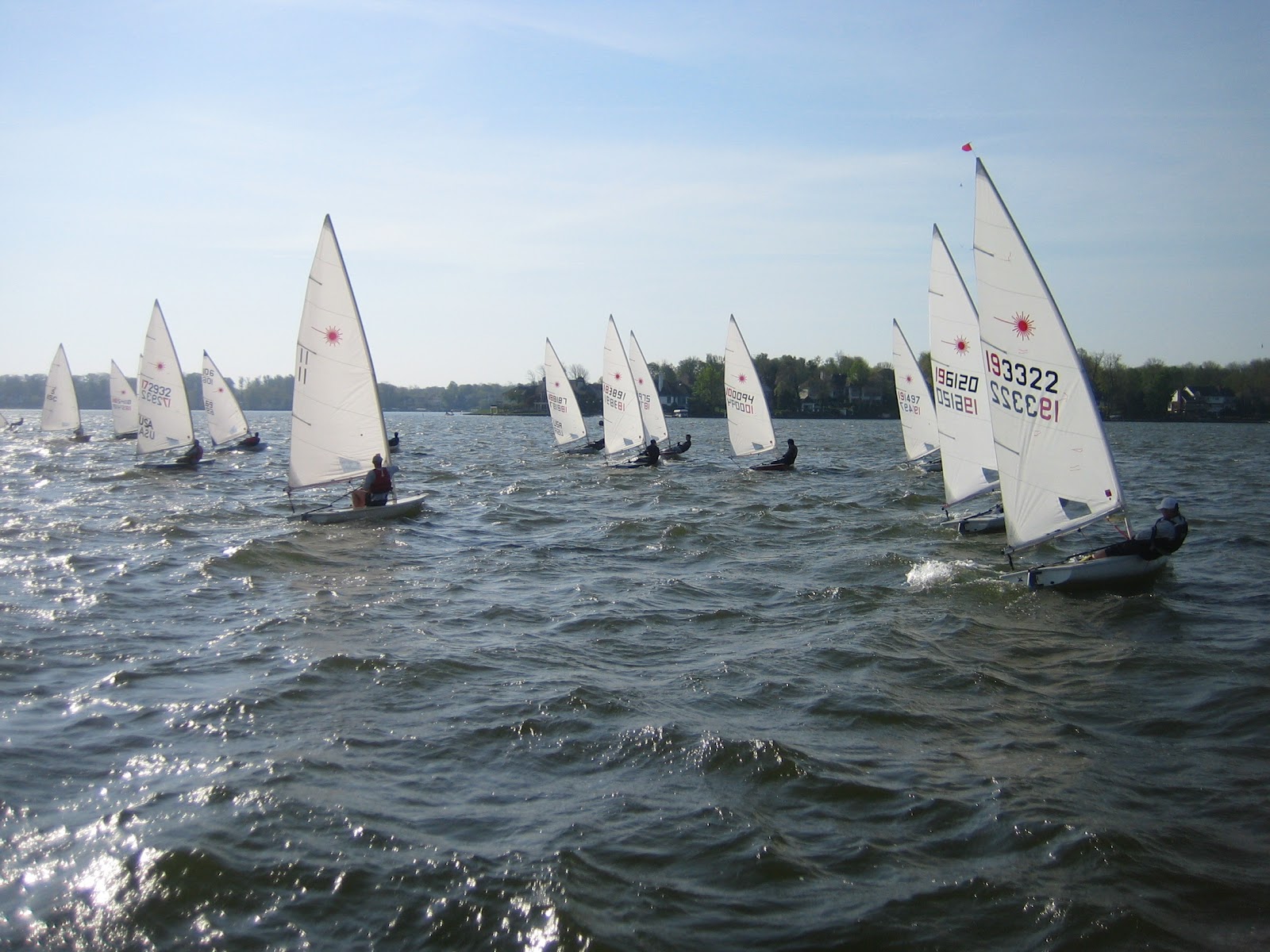
April is the windiest month of the year in Indianapolis, so come and sail your Laser or Snipe this weekend. Unlike last year when we had gusts topping 50 mph on the club anemometer, the forecast this year calls for a nice breeze in the teens for both days.

For more details, NOR, SI and registration, visit http://windy500regatta.com/

Sunday, April 13, 2014

A Load of Dribble

Now that the dust has settled on the America's Cup, designers from other classes of sail craft will no doubt be ruminating on the technology developed for the greatest trophy in Sailing.  If this trickle down continues, perhaps other classes, like the Moths, can work out how to skim upwind, or even fully foil!  And classes that allow them, like the C-Class Catamarans, may develop wing sails.

But don't get me wrong: all jesting aside, it was the best Cup I've ever seen, the boats were cool, and the setting spectacular.  But in sailing, motorsport (think Formula 1), and economics, trickle down is totally busted.

Tuesday, August 13, 2013

Upwind in the Foiling Laser!

Some bright Aussie spark has come up with this WOMBAT (Waste of Money, Brains, and Time), that's right folks, the foiling Laser!  Great fun on a broad reach, but absolutely impossible to foil upwind...until now, that is.  I've put the rocket science division here at Exploding Water hard at work to come up with some techniques to get you to the windward mark before the sun goes down.  I divided them up into three groups, and here's what they came up with:

 Shifty-lifty

"Everyone knows this beast won't beat on the foils, so don't.  Just sail on a beam reach, and work the shifts for all they're worth until you eventually get there.  You'll have the worst VMG in your club, but the best boat speed"

Chicken Tack

"Don't listen to those shifty guys, with the right sail trim and boat handling, it will in fact beat...at 89° of the windAs you near the leeward mark, pull on the controls as hard as hard as you can (Cunningham cringle past the gooseneck, and vang so hard the boom hits the gunwale). Rounding up veeery carefully - one touch of the hull to water means instant displacement mode - head up, but no more than 1° north of beam reach.  Foiling tacks are out of the question, so gybe instead! Hell, it's only 2° further than you would have tacked...  The vang is on so hard you'll have to crunch yourself into an even tinier ball than you do to tack in the conventional Laser, and you'll have to push the boom over as it scrapes the deck, but don't worry, it'll just bend more than usual and spring right back. You may have heard of or done the chicken-gybe, when you tack through 270 instead of gybing through 90 because you're scared.  Well, this is the chicken-tack, when you gybe instead!"


Beachcomber-Healover


"Down under in the basement we've come with this genius bit of inverted thinking.  When you hit the leeward mark, flip the main and rudder foils into their negative-incidence sink-mode.  The foils on this little number are so big, that unlike most yachts, this boat actually draws more water when healed over, just like Australia II! So, you heal the boat over by crouching in the cockpit (this also reduces windage, as the AC-72 yachties do), increasing the effective draft of the foils, while the sink force actually pulls you up to windward. Brilliant!  You know that Veal-Heal the Mothies do, swinging the foil lift force over to windward so the boat crabs up into the wind, this is the inverse of that..."

Sunday, April 15, 2012

Indianapolis Spring Regatta

April 14-15 @ Indianapolis Sailing Club, Geist Reservoir.  We had 25 boats out, same as last year, but well short of the mark we set back in 2006, with 64 sailors!

Tuesday, August 23, 2011

Wonder Material Invented!


I haven't posted much lately.   Partly it's because I've moved and changed jobs, but mostly it's because I've been inventing and perfecting a marvelous new material.  Everyone knows that high performance boats are made out of carbon fiber these days, but my new wonder material has some properties that really set it apart.  The aerospace industry is going to love this stuff!  I foresee widespread structural use of this material in airplanes well into the future.

Since it's the only part of a Laser you can make out of fancy materials, I fashioned a tiller and extension out of this stuff, clearly a part of the boat worth lavishing a large amount of time, money and effort over.  It's been superb.

First it's isotropic. That means has the same strength in all directions.  Imagine that!  No more delamination.  When cracks form, they start at the surface, where you can see them.  A big chunk of it has the same properties all the way through.  Quality control will be much easier - no bad layups!

It is ductile.  That means it bends before it breaks!  Perfect for when I mess up my much imitated sit-on-the-tiller-extension-tack maneuver (also invented by me, by the way).  In testing, my tiller extension has bent, but it has not broken.  I just sail on and straighten it over my knee when I'm off the water.

Related to ductility is malleability.  That means, within reason, you can smash it into the shape you want.  I didn't quite line up my holes for the u-joint rivet, so I just jammed the fastener in there and squashed the material into shape.

It's also heat-treatable.  That means you can trade off the strength (how much force it can withstand before it deforms) against the toughness (how much energy it absorbs before it breaks) of the material.  As the strength goes up, you lose ductility and toughness.  No more messing about with with laminate schedules.  Just fashion your whole assembly, bang it in the oven at the right temperature and then dump it in water or oil to quench it.

Finishing it is a breeze too.   You can just hook it up to a battery, drop it in a bucket of chemicals, and a hard, highly corrosion resistant coating forms.  I call this anodizing.

The only thing left to do now is come up for a name for this stuff.  I'm trying to decide between aluminum or aluminium.  Which do you prefer?

Thanks to my friend, IlliniRob1 for the inspiration for this post.

Friday, April 8, 2011

The ice has melted!

Photo credit Thomas Laupstad

As a tiny number of people may have noticed, the water hasn't been exploding lately...  But how can it when it's frozen?  It's not even water!

My winter is over and I'm going sailing tomorrow!

Tuesday, June 8, 2010

Have you named your boat?

And now you know from this less-than-meticulously composed photo where the name of this blog comes from.  As for where the name of the boat comes from, that's a slightly more interesting story.  As my brother and a Chinese colleague found out a few years ago, this is what you get using an online tool when you translate our last name into Chinese and back into English.  I think it's also a pretty good description of what it's like to be planing in a Laser.  I'd had the boat for about a year before I realized it would make a good name for it, but at least I got around to it and named the boat, with decal and all.  That decal I had made by Compliance Signs, of Chicago Illinois, which, as you might guess, specializes in safety signs. Even though it was a custom job, they charged me only around six bucks for this decal.

I was a little surprised when I went to two regattas last summer with around 30 Lasers entered in each, that on both occasions, I was one of only two sailors who'd name their boats.  Why is this?  Is it because Laser sailors are all business with no time for such frivolous exploits as naming boats?  Is it maybe because the boats are all so alike (if you drink the Kool-Ade) that the boat is irrelevant, but a conduit to express the sailor's individual brilliance as a skipper?  Maybe just apathy?

By choosing a name that sounds like tumultuous water, I may have violated this oft-quoted advice for naming boats by tempting fate.  (Any one know who first wrote those wise words, by the way?)  However, despite all the spectacular videos you'll find if you search for "exploding water", everyone knows, water cannot explode, at least not literally.

Naming boats is not easy, but it is fun, especially if you think up names with friends.  And so I return to my original question: Have you named your boat?

Wednesday, June 2, 2010

Chockablock!

One of the things I like about sailing is it's rich vocabulary, and the way has given it's words and expressions to general usage.  Expressions like "leaving yourself leeway", "having the wind knocked out of your sails", "liking the cut of someone's jib", and "being stuck in the doldrums" are so commonplace in everyday use that most people don't stop to think about where they come from.

As an aeronautical engineer, I love the aviation terms that have come from sailing - rolling, pitching, and yawing; surging, swaying, and heaving; buttlines, waterlines and stations, and indeed the name of the field itself, aeronautics. Bulkheads, rudders and strakes, the list goes on and on.

I'd been sailing for many years before I realized that the term chockablock comes from sailing.  The first definition given by Webster's is pulled so tight as to have the blocks touching, and the etymology refers to the preceding entry, chock, another bit of nautical hardware.  I'm not sure if the "chock" in chockablock comes from that type of chock or from the chocks, or cheeks of a block, but either way, I like the expression a lot more now that I know where it comes from.

We Laser sailors often talk about being two-blocked, or block to block, but i think we should revive this nautical term and instead say chockablock!

Tuesday, May 4, 2010

Race for Z-Prix Heats Up! May 4, 2034

Sailing in the second Space Age.


Excitement is building in the Z-Prix competition for the first solar sail propelled vehicle to leave the solar system, that is to cross the threshold known as the heliopause.  Surprising everyone but herself, the competition was sponsored by Ansari Dhuka, oil sheik, after an epiphany in the sun-scorched Empty Quarter of Saudi Arabia.  For the subsidized price of $6m, teams are supplied launch services into low earth orbit.  From there, they must proceed propelled only by the sun, driven by enormous solar sails.  The teams are chasing a $10m prize for being the first to leave the solar system, and a consolation $6m prize for being the fastest, i.e. quickest voyage to deep space.  Spectators can check the progress of the race and solar weather reports at z-prix.org. Here are snapshots of the four most serious entrants to the competition.

Icarus - Designed by a team of hot-headed Greek engineers, this audacious effort calls for a risky mission involving mind-bogglingly complicated orbit transfers and multiple, close flybys of the sun.  The flight plan is considered brilliant, but the red-hot rays may be just too dazzling for the space craft to survive its close encounters with the sun.  Sponsor: Onasis Odysseus, Greek Shipping Magnate. Odds: 10 to 1, but will surely shorten if the craft survives its first solar flyby next month.

Ufudu - Meaning tortoise in Zulu, this spacecraft is indeed slow but steady.  Blasting off in 2021, it was by more than a decade the first mission to launch. A simple system with a conventional mission plan.  Plodding ahead of their competition, they have already cleared Mars and the treacherous asteroid belt.  Co-sponsors: Marx Shuttlecock, South African IT wizard, famous supporting open source software and for being one of the first space tourists. Nicknamed "the Afronaut".  Oxen Musk, South African pioneer of electric cars and commercial space flight.  Odds on, hot favorite with the bookies. 4 to 3

Solntse - This Russian entrant is seeking to win the competition through sheer sail power.  Measuring 5 km in diameter, the mass of the sail exceeds the mass of the hull by a factor of 8 to 1.  Some have frowned upon the use of nuclear technology to power control and communication systems, where all other teams have relied on photovoltaic cells. The response from the design team has been, "Russian technology likes abuse! It's simple and robust.  Let's see how well those photovoltaic systems from the other teams work once they're out past the Kuiper Belt".  Scheduled to launch later this year.  Sponsor: Vladimir Khodorkovsky, heir of oligarch. Widely mocked for his perpetual tan and habit of strutting on Black Sea beaches. Odds: 20 to 1.

Sun Devil II.  Designed and built by students and faculty at Arizona State University, this is a solid-looking entry, sporting inflatable sails.  Currently making it's way out of earth orbit.  Multiple aerospace industry sponsors.  Odds: 2 to 1.

A writing project suggested by Tillerman

Tuesday, April 20, 2010

High vs Higher Performance Sailing by Frank Bethwaite


Several big online book retailers have made the mistake that Higher Performance Sailing is merely the second edition of High Performance Sailing.  It is not.  It is a completely new book.  I know this from my own correspondence with the author, and I recently got hold of both books.

To this sailor, engineer, and workshop tinkerer, they are nothing short of inspirational.  So far, I've only dipped into the books in places, but I'm already inspired by the advances the Bethwaites made by careful thought, clever experiments, and bold new thinking carried forward into practice.  These books remind me of Carrol Smith's classic book on motorsport engineering, Tune to Win, the pinnacle of his much admired "... to Win" series.

To get back to my original point, the books, referred to by Frank Bethwaite himself as HPS1 and HPS2, are two distinct works.

So, instead, here's something useful which would be difficult to find elsewhere online, the table of contents of both books:

High Performance Sailing

Ch. 1  The Racing Helmsman's Wind
Ch. 2  The Gradient Wind
Ch. 3  The Two Surface Winds
Ch. 4  Light Airs
Ch. 5  The Breeze over a Cool Surface
Ch. 6  Friction and the Wind-Wave Patterns
Ch. 7  Heat and Thermal Patterns
Ch. 8  Winds near Clouds
Ch. 9  Winds near Shores
Ch. 10 Wind Appraisal and the Stability Index
Ch. 11 Race Preparation
Ch. 12 Sailing the Wind Patterns
Ch. 13 Waves
Ch. 14 Depth and the Warm Surface Layer
Ch. 15 Currents and Tidal Stream
Ch. 16 The Quest for Speed
Ch. 17 Sails
Ch. 18 Rigs
Ch. 19 Foils
Ch. 20 Hulls
Ch. 21 Scope
Ch. 22 Handling to Windward
Ch. 23 Kinetics
Ch. 24 Sailing Crosswind
Ch. 25 Sailing Downwind

Higher Performance Sailing

Ch. 1  The Origins of High Performance   
Ch. 2  The State of the Extreme Arts
Ch. 3  Review of Wind Dynamics
Ch. 4  The Spectrum of the Wind
Ch. 5  The Quick Gust Peaks
Ch. 6  Surges and Fades
Ch. 7  The Drive to Sail Faster
Ch. 8  The Materials Revolution
Ch. 9  The Design Response
Ch. 10 Hulls that Don't Baulk
Ch. 11 More Power - Trapezes and Wings
Ch. 12 Handicaps, Performance Equalizations, and Turns per Mile
Ch. 13 Sail Forces in Steady Airflow
Ch. 14 Evolution of the B-18 Marque
Ch. 15 Design Refinement for Long-course Speed (by Julian Bethwaite)
Ch. 16 Design Refinement for Short-course Maneuverability
Ch. 17 The 49er
Ch. 18 Transition Years
Ch. 19 The 29er
Ch. 20 The Critical Ratios
Ch. 21 The Evolution of Manual Adjustment
Ch. 22 The Automatic Rig
Ch. 23 The Evolution of the Sailing Simulator
Ch. 24 A New Way of Thinking
Ch. 25 The Simulator Printout
Ch. 26 Fast Handling Technique
Ch. 27 Handling an Apparent Wind Skiff
Ch. 28 Sailing the Foil Moth (by Rohan Veal)
Ch. 29 Racing with Speed: 'Connecting the Dots'

Safe trip over water


Fishing hooks made by the Mauri in New Zealand have evolved from being functional hooks made of whale bone to being ornamental good luck charms made of various materials.  Whale bone is now rare, so bleached cow bone is often used instead, and moving to more exotic materials, they are often made of jade, or greenstone, as it is locally known.  This particular one is made out of metal and paua shell, which is similar to mother of pearl.

Ornaments of different shapes have different meanings.  The triple twist signifies two people or cultures joining together for eternity, while the single twist represents the paths of individuals, separating and coming back together, (which is apt given the "overseas experience" had by many young people living on an isolated island nation).  The spiral signifies the unfurling fern bud and connotes new beginnings, while the Hei Tiki brings fertility.  The fishing hook is meant to bring strength, good luck and prosperity, and safe journeys over water.

In related news, my parents are home from New Zealand.  Thanks, Mom and Dad.

Thursday, April 1, 2010

Walkabout


Back from my walkabout. First time I've driven my car to the sea. So, customary sporadic service could have resumed today, but instead it will tomorrow. Probably.

Friday, March 19, 2010

Beautiful Stranger


I was going to write a post with some original content, but once the idea popped into my head, how could I resist a song with this title, especially given the Austin Powers segue?

Thursday, March 18, 2010

Even Stranger Cargo


Some more William Orbit. Early 90's psychedelia from his Strange Cargo III Album. (insert Austin Powers voice) Groovy Baby, Yeah!

Friday, March 12, 2010

Strange Cargo Hinterland - William Orbit - Million City


Like a lot of electronic music worth listening to, it takes about a minute to get going. What cities can you identify?

Wednesday, March 10, 2010

Deep Water: The Loneliness of a Long Distance Liar


I watched this gripping documentary alone over the weekend, and it put me in a funky mood. It revolves around the strange and tragic last voyage of Donald Crowhurst, an entrant into The Golden Globe race, that set off in 1968. Francis Chichester had recently sailed around the world single-handedly, stopping only in Sydney to make repairs. This success, and the sensation it caused prompted the Sunday Times to organize a single-handed, nonstop race around the world. In addition to Deep Water (2006), Crowhurst's failure which presumably ended in suicide inspired the book, The Strange Last Voyage of Donald Crowhurst by Nicholas Tomalin and Ron Hall.

A struggling inventor, Crowhurst signed a contract with a promoter worth £5000 requiring him to enter the race and to not drop out too early. Despite his recognition that his own made boat was not ready, he put on a brave face for interviewing journalists, and set off on the last day before the deadline, imposed by the race organizers to avoid winter in the Southern Ocean.

Immediately, he ran into problems, fouling the main halyard on the buoyancy bag on the masthead, if full view of the on-looking press. Once underway, the outriggers of his trimaran started taking on water through their numerous leaky hatches. From the very start, he was deliberately vague in his position reports. By the time he made it to the trade winds north of the equator, he started issuing false progress reports, and keeping two sets of logs. His deceptions and lies pushed him to further deceptions and lies. At this point, strange obsessions entered Crowhurst's logs . The number 243 cropped up repeatedly. He reported covering 243 miles in a day, which would have been a single-handed record. In addition, he had planned on finishing the race in 243 days.

He now knew that his boat was not adequately seaworthy for the Southern Ocean. Through his lies, he had backed himself into a corner. After a certain point, he couldn't retire from the race without exposing himself as fraud, because he was supposed to be thousands of miles beyond the ports he would have pulled into.

After ruling out that option for himself, he concocted a new deception. He would loiter in the South Atlantic, off the coast of Brazil until the race leaders had rounded Cape Horn and headed north. Now he couldn't make any radio broadcasts, as those would give away his position. By the time he broke his radio silence, Robin Knox-Johnson had already finished, winning the Golden Globe, as first to finish. To avoid close scrutiny of his faked logs with fake celestial observations, his plan was to now finish more slowly than Nigel Tetley, who was on course to win £5000 for the fastest voyage. Then, only 1200 miles from the finish, Tetley sank. Now in real danger of making the fastest voyage, and being uncovered upon the inspection of his logs. He went insane as evidenced by his delusional and incoherent log entries. As his log entries ended that day with what's taken to be suicide note, he is presumed to have taken his life on 1969, July 1st, the 243rd day of the year.

A big lesson to be taken from this tragedy, is the loneliness of holding a deep and dark secret and confiding in no one. In fact, can there be anything lonelier than telling such a lie?  Also, as with all big lies, and as the experiences of Presidents Nixon and Clinton illustrate, lies beget more lies in an ever more tangled web of deceit.  The best thing to do is to swallow one's pride and admit the truth.

Monday, March 8, 2010

Book Review: Ben Ainslie - The Laser Campaign Manual


After I'd had my Laser for a while, I thought I could do with a more modern book on sailing it. I couldn't decide between this one and Dick Tillman's Complete Book of Laser Sailing, so in the end I ordered both to find out which one was better. I won't make judgment on that directly since the books have different strengths, but in terms of how to sail the boat fast without any nonsense, this is the book you want.

The book is extremely well organized. Each point of sail and each maneuver (tacking and gybing, etc.) is rigorously covered in medium, heavy and light airs. Each of these chunks is illustrated with color pictures, with nice sequences for the tacks, gybes and 720, mark roundings and start. The book was clearly thoroughly planned before the photos were taken on the water. For each point of sail at each wind strength he gives recommended sail trim settings and body positions, and lists common mistakes. He avoids long tracts of prose, breaking it down into small chunks with headings, even bulleted lists, making the book very easy to navigate and digest.

An Olympic gold and silver medalist in the class, his credentials are beyond dispute, and from an engineering point of view, I agree with him on almost everything that he says about what makes the boat go fast. I don't always agree with his explanation for why these techniques are fast, but ultimately that's of secondary importance. For instance, he gets muddled up in his explanation of fullness of the sail on the reach, drawing a half-baked analogy to a jet airplane wing, confusing chord with camber, all of which jar to this aeronautical engineer. He's a layman engineer, but an expert sailor, and ultimately, the sailing expertise is what we want from the book.

As I posted earlier, for Ed Baird, tactics were a major part of Laser sailing. For Ainslie, it's all about boat speed. He subscribes to the point of view that "boat speed makes you a tactical genius". Upwind, stay in close proximity to the front runners, or if ahead, keep in between them and the windward mark. Sailing off the wind, learn how to use the waves maximum advantage, deviating substantially from the rhumb line if need be. In short, sail fast.

As a mediocre sailor with distinctly average boat speed, I feel I have to try harder than this on tactics and reading the wind. For one thing, you can't stay close to the front runners if they're way ahead of you! So, if you can't outrun them, at least try'n outwit them.

Sunday, March 7, 2010

Marooned on Islands in the Car-chipelago


That's what the title of the previous post should have been...

Friday, March 5, 2010

Stuck in suburban gulags

When I was a child, I lived for two years in a New Jersey suburb of Philadelphia. When I think back to those times, I'm often struck by how small a world it was we lived in. I don't mean the world in the sense of the planet - my native South Africa seemed a million miles away - but in the sense of how far afield my friends and I could roam under our own steam. We lived in a small subdivision of 64 houses (I just counted on Google maps) abutted on the west by a four lane road without sidewalks. It was like a moat, a conduit we could traverse or travel down only by car. South of our development was an open field and then some woods with a stream running through it. To the east and north were farm fields, but in what seemed like a daring act of trespass, we would sometimes cut along the edge of the field to make it to the next subdivision, that was similarly isolated.

Today the weather was nice enough for me to cycle for the first time in months, and I wanted to do some errands while I was out. Going to the library was no problem, but the bank was just out of reach. For the lack of a safe way of traveling down a quarter mile of four lane, 45 mph road at rush hour, I just couldn't make it! There was no alternative route because this is the only road for miles that crosses the DuPage river. And no surprises, the next road that does is also a busy four-laner flanked by curbs rather than shoulders. I could see the bank, but I couldn't get there for the lack of a car. As I cycled home so that I could drive there instead, I was struck by the madness of the way we confine ourselves to suburban gulags, imprisoned by the barriers of major roads, impassable to all but cars.

The pedestrian and cyclist are really second class citizens here in the US. Late at night when the seating area was closed, I was once denied service at a McDonald's drive-through because I wasn't in a car. I was livid, and felt discriminated against by a policy utterly lacking in common sense. I've lived in subdivisions in Illinois and Alabama that didn't even have sidewalks! What were the plan commissions thinking, that in the future we'd chop off our legs at birth and ride around on Segways?

I'm trying to come up with the best term to describe this suburban isolation imposed on pedestrians and cyclists. "Archipelagos" is maybe more descriptive, but it lacks the ominous, overbearing and entrapped connotation of "gulags". Any ideas?

Tuesday, March 2, 2010

Book Review: Laser Sailing - Ed Baird


These days, Ed Baird is probably best known for his exploits with Alinghi and on the World Match Racing Tour, but like so many other top skippers of big boats, he got his start in the Laser. The 1980 world champ in the class wrote this book when men were men, and used to do acrobatics in the boat to put the vang on and tension the outhaul. It was written even before the sailcloth weight was increased from 3.2 oz to 3.8 oz, which precipitated multi-purchase systems with thimbles, which eventually led to the proper, modern sail controls we have today.

I got this book from my dad when he generously gave me his Laser. (I asked if I could borrow the boat for the summer - he said sure, and a few weeks later he called me and told me I could keep it!) The book is brief and well organized. He breaks it down into four chapters, covering the boat, your body, the race, and mental attitude. The race he covers in the order in which you encounter the phases - start, beat, tacking, reaching, etc - and illustrates the important techniques with series of photographs.

A few notable things stand out about this book. On techniques he covers a few things I haven't seen other authors and pundits mention. He describes a really clever trick of pulling the sail down into the water using the main sheet after a capsize to windward, which lets you right the boat without it capsizing again. He illustrates this with series of photos that finishes up with a delightful grin of his that says without saying, "I didn't even get my feet wet!". He's also the only person I've seen distinguish between the reach to reach gybe and the run to run gybe. Think about it - it really is different. A gybe from by-the-lee to by-the-lee involves heading up.

Coming back to this book after reading Ben Ainslie's (to be reviewed soon), I was struck that there really is nothing new under the sun. As Ben Ainslie has it, the technique of "s-curving" on the run was invented by Robert Scheidt and Peter Transcheidt in the early 90's, but in Baird we find, "Sail by the lee, pumping (legally!) and heading up whenever you need power to surf down a wave". Likewise when I read in Ainslie that you should steer up when going over waves, this flat water sailor without experience of it, but armed with an understanding of the wave mechanics thought it was brilliant! And then, again I read the same pearls of wisdom in Baird's book nestled in a nonchalant manner. Maybe Ainslie was sufficiently heavy, tall, and fit to not need to do it, but Baird stresses the importance of easing the main on a heavy air beat and when ducking transoms to keep the boat flat, fast, and maneuverable.

All top sailors realize that it is a multifaceted sport requiring fitness, tactics, and boat speed, but focus of these guys, and the reasons for their success varies. What really shines through in Baird's book is his tactical brilliance. He was an early adopter of the tactical compass with a zero to 20 scale and pairs of lubber lines, invented by Anders Ansar. Ansar specifically mentions Baird's use of the compass in his story of how he invented it, and quotes him in his description of his first racing compass. Much more than that, though, I am impressed by his unveiling of numerous tactical tricks.