"Life on a blue planet" was the best phrase I could come up with to sum up what I anticipated would be the content of this blog. I'll try to limit myself to that admittedly broad topic. Ironically, the photo I use as my profile image was taken by an Apollo 17 astronaut, a life form not on this blue planet...

Sunday, April 15, 2012

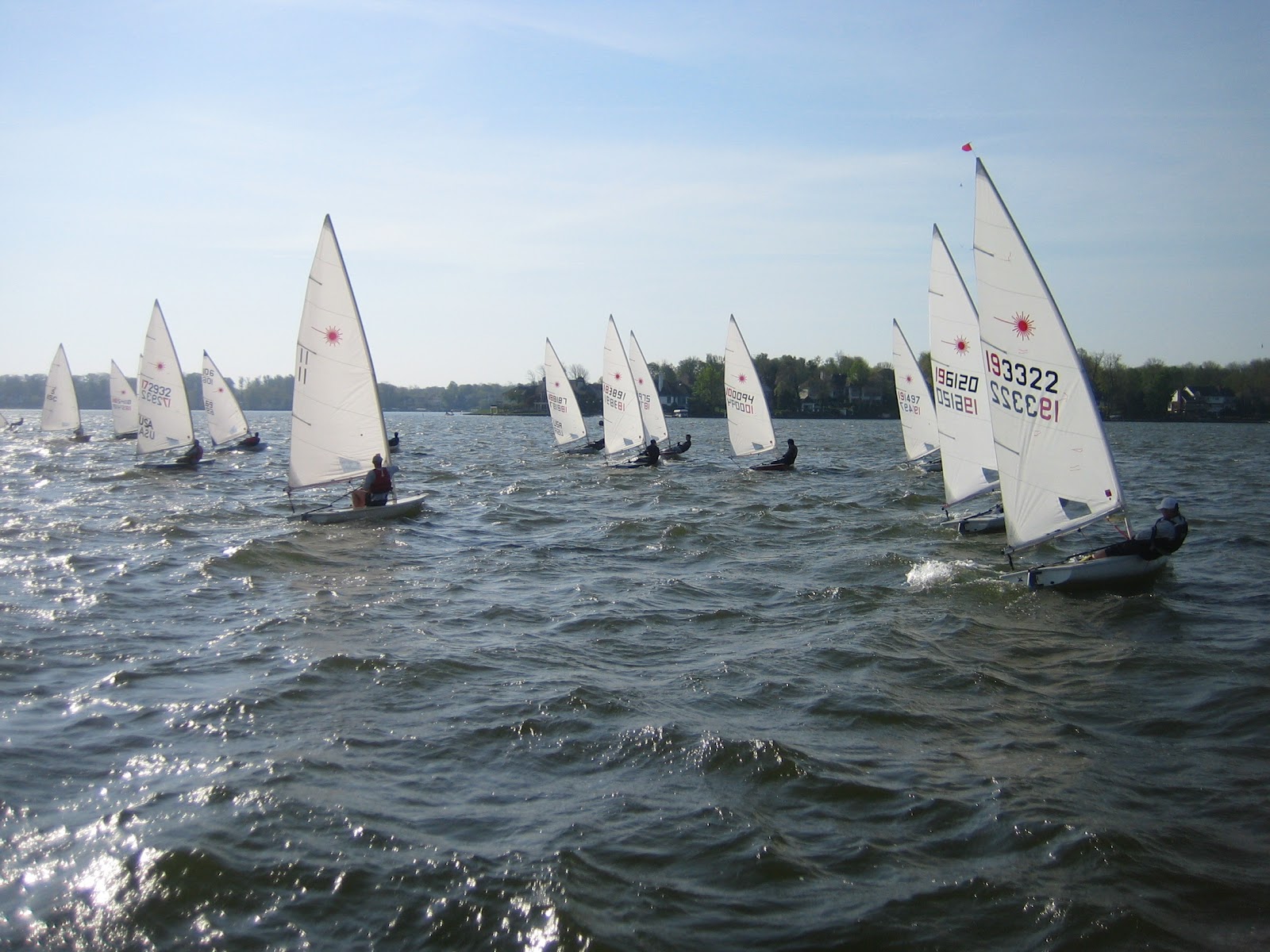
Indianapolis Spring Regatta

April 14-15 @ Indianapolis Sailing Club, Geist Reservoir.  We had 25 boats out, same as last year, but well short of the mark we set back in 2006, with 64 sailors!

Tuesday, August 23, 2011

Wonder Material Invented!


I haven't posted much lately.   Partly it's because I've moved and changed jobs, but mostly it's because I've been inventing and perfecting a marvelous new material.  Everyone knows that high performance boats are made out of carbon fiber these days, but my new wonder material has some properties that really set it apart.  The aerospace industry is going to love this stuff!  I foresee widespread structural use of this material in airplanes well into the future.

Since it's the only part of a Laser you can make out of fancy materials, I fashioned a tiller and extension out of this stuff, clearly a part of the boat worth lavishing a large amount of time, money and effort over.  It's been superb.

First it's isotropic. That means has the same strength in all directions.  Imagine that!  No more delamination.  When cracks form, they start at the surface, where you can see them.  A big chunk of it has the same properties all the way through.  Quality control will be much easier - no bad layups!

It is ductile.  That means it bends before it breaks!  Perfect for when I mess up my much imitated sit-on-the-tiller-extension-tack maneuver (also invented by me, by the way).  In testing, my tiller extension has bent, but it has not broken.  I just sail on and straighten it over my knee when I'm off the water.

Related to ductility is malleability.  That means, within reason, you can smash it into the shape you want.  I didn't quite line up my holes for the u-joint rivet, so I just jammed the fastener in there and squashed the material into shape.

It's also heat-treatable.  That means you can trade off the strength (how much force it can withstand before it deforms) against the toughness (how much energy it absorbs before it breaks) of the material.  As the strength goes up, you lose ductility and toughness.  No more messing about with with laminate schedules.  Just fashion your whole assembly, bang it in the oven at the right temperature and then dump it in water or oil to quench it.

Finishing it is a breeze too.   You can just hook it up to a battery, drop it in a bucket of chemicals, and a hard, highly corrosion resistant coating forms.  I call this anodizing.

The only thing left to do now is come up for a name for this stuff.  I'm trying to decide between aluminum or aluminium.  Which do you prefer?

Thanks to my friend, IlliniRob1 for the inspiration for this post.

Friday, April 8, 2011

The ice has melted!

Photo credit Thomas Laupstad

As a tiny number of people may have noticed, the water hasn't been exploding lately...  But how can it when it's frozen?  It's not even water!

My winter is over and I'm going sailing tomorrow!

Tuesday, June 8, 2010

Have you named your boat?

And now you know from this less-than-meticulously composed photo where the name of this blog comes from.  As for where the name of the boat comes from, that's a slightly more interesting story.  As my brother and a Chinese colleague found out a few years ago, this is what you get using an online tool when you translate our last name into Chinese and back into English.  I think it's also a pretty good description of what it's like to be planing in a Laser.  I'd had the boat for about a year before I realized it would make a good name for it, but at least I got around to it and named the boat, with decal and all.  That decal I had made by Compliance Signs, of Chicago Illinois, which, as you might guess, specializes in safety signs. Even though it was a custom job, they charged me only around six bucks for this decal.

I was a little surprised when I went to two regattas last summer with around 30 Lasers entered in each, that on both occasions, I was one of only two sailors who'd name their boats.  Why is this?  Is it because Laser sailors are all business with no time for such frivolous exploits as naming boats?  Is it maybe because the boats are all so alike (if you drink the Kool-Ade) that the boat is irrelevant, but a conduit to express the sailor's individual brilliance as a skipper?  Maybe just apathy?

By choosing a name that sounds like tumultuous water, I may have violated this oft-quoted advice for naming boats by tempting fate.  (Any one know who first wrote those wise words, by the way?)  However, despite all the spectacular videos you'll find if you search for "exploding water", everyone knows, water cannot explode, at least not literally.

Naming boats is not easy, but it is fun, especially if you think up names with friends.  And so I return to my original question: Have you named your boat?

Wednesday, June 2, 2010

Chockablock!

One of the things I like about sailing is it's rich vocabulary, and the way has given it's words and expressions to general usage.  Expressions like "leaving yourself leeway", "having the wind knocked out of your sails", "liking the cut of someone's jib", and "being stuck in the doldrums" are so commonplace in everyday use that most people don't stop to think about where they come from.

As an aeronautical engineer, I love the aviation terms that have come from sailing - rolling, pitching, and yawing; surging, swaying, and heaving; buttlines, waterlines and stations, and indeed the name of the field itself, aeronautics. Bulkheads, rudders and strakes, the list goes on and on.

I'd been sailing for many years before I realized that the term chockablock comes from sailing.  The first definition given by Webster's is pulled so tight as to have the blocks touching, and the etymology refers to the preceding entry, chock, another bit of nautical hardware.  I'm not sure if the "chock" in chockablock comes from that type of chock or from the chocks, or cheeks of a block, but either way, I like the expression a lot more now that I know where it comes from.

We Laser sailors often talk about being two-blocked, or block to block, but i think we should revive this nautical term and instead say chockablock!

Tuesday, May 4, 2010

Race for Z-Prix Heats Up! May 4, 2034

Sailing in the second Space Age.


Excitement is building in the Z-Prix competition for the first solar sail propelled vehicle to leave the solar system, that is to cross the threshold known as the heliopause.  Surprising everyone but herself, the competition was sponsored by Ansari Dhuka, oil sheik, after an epiphany in the sun-scorched Empty Quarter of Saudi Arabia.  For the subsidized price of $6m, teams are supplied launch services into low earth orbit.  From there, they must proceed propelled only by the sun, driven by enormous solar sails.  The teams are chasing a $10m prize for being the first to leave the solar system, and a consolation $6m prize for being the fastest, i.e. quickest voyage to deep space.  Spectators can check the progress of the race and solar weather reports at z-prix.org. Here are snapshots of the four most serious entrants to the competition.

Icarus - Designed by a team of hot-headed Greek engineers, this audacious effort calls for a risky mission involving mind-bogglingly complicated orbit transfers and multiple, close flybys of the sun.  The flight plan is considered brilliant, but the red-hot rays may be just too dazzling for the space craft to survive its close encounters with the sun.  Sponsor: Onasis Odysseus, Greek Shipping Magnate. Odds: 10 to 1, but will surely shorten if the craft survives its first solar flyby next month.

Ufudu - Meaning tortoise in Zulu, this spacecraft is indeed slow but steady.  Blasting off in 2021, it was by more than a decade the first mission to launch. A simple system with a conventional mission plan.  Plodding ahead of their competition, they have already cleared Mars and the treacherous asteroid belt.  Co-sponsors: Marx Shuttlecock, South African IT wizard, famous supporting open source software and for being one of the first space tourists. Nicknamed "the Afronaut".  Oxen Musk, South African pioneer of electric cars and commercial space flight.  Odds on, hot favorite with the bookies. 4 to 3

Solntse - This Russian entrant is seeking to win the competition through sheer sail power.  Measuring 5 km in diameter, the mass of the sail exceeds the mass of the hull by a factor of 8 to 1.  Some have frowned upon the use of nuclear technology to power control and communication systems, where all other teams have relied on photovoltaic cells. The response from the design team has been, "Russian technology likes abuse! It's simple and robust.  Let's see how well those photovoltaic systems from the other teams work once they're out past the Kuiper Belt".  Scheduled to launch later this year.  Sponsor: Vladimir Khodorkovsky, heir of oligarch. Widely mocked for his perpetual tan and habit of strutting on Black Sea beaches. Odds: 20 to 1.

Sun Devil II.  Designed and built by students and faculty at Arizona State University, this is a solid-looking entry, sporting inflatable sails.  Currently making it's way out of earth orbit.  Multiple aerospace industry sponsors.  Odds: 2 to 1.

A writing project suggested by Tillerman

Tuesday, April 20, 2010

High vs Higher Performance Sailing by Frank Bethwaite


Several big online book retailers have made the mistake that Higher Performance Sailing is merely the second edition of High Performance Sailing.  It is not.  It is a completely new book.  I know this from my own correspondence with the author, and I recently got hold of both books.

To this sailor, engineer, and workshop tinkerer, they are nothing short of inspirational.  So far, I've only dipped into the books in places, but I'm already inspired by the advances the Bethwaites made by careful thought, clever experiments, and bold new thinking carried forward into practice.  These books remind me of Carrol Smith's classic book on motorsport engineering, Tune to Win, the pinnacle of his much admired "... to Win" series.

To get back to my original point, the books, referred to by Frank Bethwaite himself as HPS1 and HPS2, are two distinct works.  At this point I'd like to make some nerdy and mildly witty quasi mathematical proof Tillerman might like, that since higher is greater than high, higher cannot equal high, therefore HPS1 cannot equal HPS2.  But it would have been way too much hassle to figure out how to make that look nice in this blog with Latex or html mathematical notation.  And now that it's written in words, it looks even more nerdy and less witty...

So, instead, here's something useful which would be difficult to find elsewhere online, the table of contents of both books:

High Performance Sailing

Ch. 1  The Racing Helmsman's Wind
Ch. 2  The Gradient Wind
Ch. 3  The Two Surface Winds
Ch. 4  Light Airs
Ch. 5  The Breeze over a Cool Surface
Ch. 6  Friction and the Wind-Wave Patterns
Ch. 7  Heat and Thermal Patterns
Ch. 8  Winds near Clouds
Ch. 9  Winds near Shores
Ch. 10 Wind Appraisal and the Stability Index
Ch. 11 Race Preparation
Ch. 12 Sailing the Wind Patterns
Ch. 13 Waves
Ch. 14 Depth and the Warm Surface Layer
Ch. 15 Currents and Tidal Stream
Ch. 16 The Quest for Speed
Ch. 17 Sails
Ch. 18 Rigs
Ch. 19 Foils
Ch. 20 Hulls
Ch. 21 Scope
Ch. 22 Handling to Windward
Ch. 23 Kinetics
Ch. 24 Sailing Crosswind
Ch. 25 Sailing Downwind

Higher Performance Sailing

Ch. 1  The Origins of High Performance   
Ch. 2  The State of the Extreme Arts
Ch. 3  Review of Wind Dynamics
Ch. 4  The Spectrum of the Wind
Ch. 5  The Quick Gust Peaks
Ch. 6  Surges and Fades
Ch. 7  The Drive to Sail Faster
Ch. 8  The Materials Revolution
Ch. 9  The Design Response
Ch. 10 Hulls that Don't Baulk
Ch. 11 More Power - Trapezes and Wings
Ch. 12 Handicaps, Performance Equalizations, and Turns per Mile
Ch. 13 Sail Forces in Steady Airflow
Ch. 14 Evolution of the B-18 Marque
Ch. 15 Design Refinement for Long-course Speed (by Julian Bethwaite)
Ch. 16 Design Refinement for Short-course Maneuverability
Ch. 17 The 49er
Ch. 18 Transition Years
Ch. 19 The 29er
Ch. 20 The Critical Ratios
Ch. 21 The Evolution of Manual Adjustment
Ch. 22 The Automatic Rig
Ch. 23 The Evolution of the Sailing Simulator
Ch. 24 A New Way of Thinking
Ch. 25 The Simulator Printout
Ch. 26 Fast Handling Technique
Ch. 27 Handling an Apparent Wind Skiff
Ch. 28 Sailing the Foil Moth (by Rohan Veal)
Ch. 29 Racing with Speed: 'Connecting the Dots'